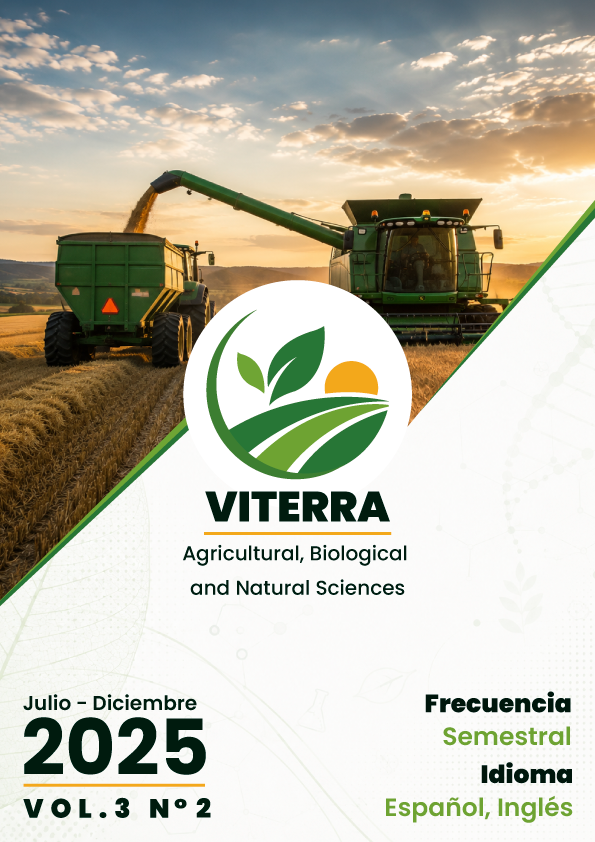
Digital transformation of agriculture: global trends
Keywords:
digital agriculture, smart farming, artificial intelligence, agricultural innovation, emerging technologies, digital transformation.Abstract
The digital transformation of agriculture constitutes one of the main technological innovation processes experienced by contemporary agri-food systems. The incorporation of artificial intelligence, the Internet of Things, precision agriculture, robotics, sensors, autonomous vehicles, digital platforms, geographic information systems, big data analytics, and satellite technologies is progressively modifying agricultural production, management, and marketing processes. The objective of this article was to analyse global trends in the digital transformation of agriculture, identifying the main emerging technologies, their applications, benefits, challenges, and development prospects. A systematic review of scientific and documentary literature was conducted through the consultation of academic publications, institutional reports, and specialised documents related to digital agriculture, technological innovation, and agri-food sustainability. The review considered international sources and recent studies focused on analysing agricultural digitalisation processes. The results reveal a significant expansion of artificial intelligence, automation, intelligent decision-support systems, data-driven agriculture, and remote monitoring technologies. These innovations contribute to optimising resource use, increasing productivity, reducing costs, anticipating climate risks, and strengthening the sustainability of production systems. However, challenges persist regarding the digital divide, technological costs, rural connectivity, training, interoperability, data governance, and cybersecurity. It is concluded that digital transformation represents a strategic opportunity to build more efficient, resilient, and sustainable agricultural systems, although its consolidation requires inclusive policies, technological infrastructure, research, innovation, and the strengthening of farmers’ digital capabilities.
Downloads
References
World Bank. (2021). What’s cooking: Digital transformation of the agrifood system. https://openknowledge.worldbank.org/handle/10986/35216
Trendov, N. M., Varas, S., & Zeng, M. (2019). Digital technologies in agriculture and rural areas: Status report. Food and Agriculture Organization of the United Nations. https://www.fao.org/3/ca4985en/ca4985en.pdf
Benos L, Bechar A, Bochtis D. Machine learning in agriculture: A comprehensive updated review. Sensors. 2021;21(11):3758. https://doi.org/10.3390/s21113758.
Klerkx L, Rose D. Dealing with the game-changing technologies of Agriculture 4. 0: How do we manage diversity and responsibility in food system transition pathways? Global Food Security. 2020;24:100347. https://doi.org/10.1016/j.gfs.2019.100347.
Liakos KG, Busato P, Moshou D, Pearson S, Bochtis D. Machine learning in agriculture: A review. Sensors. 2018;18(8):2674. https://doi.org/10.3390/s18082674.
Javaid M, Haleem A, Khan IH, Suman R. Understanding the potential applications of artificial intelligence in agriculture sector. Advanced Agrochem. 2022;1(1):15-30. https://doi.org/10.1016/j.aac.2022.10.001.
Fielke S, Taylor B, Jakku E. Digitalisation of agricultural knowledge and advice networks: A state-of-the-art review. Agricultural Systems. 2020;180:102763. https://doi.org/10.1016/j.agsy.2019.102763.
Basso B, Antle J. Digital agriculture to design sustainable agricultural systems. Nature Sustainability. 2020;3:254-256. https://doi.org/10.1038/s41893-020-0510-0.
Saiz-Rubio V, Rovira-Más F. From smart farming towards agriculture 5. 0: A review on crop data management. Agronomy. 2020;10(2):207. https://doi.org/10.3390/agronomy10020207.
World Economic Forum. (2024, septiembre 9). Así es como la innovación tecnológica ayuda a los pequeños agricultores. https://www.weforum.org/stories/2024/09/innovation-technology-smallholder-farmers/
Klerkx, L., Jakku, E., & Labarthe, P. (2019). A review of social science on digital agriculture, smart farming and agriculture 4.0: New contributions and a future research agenda. NJAS: Wageningen Journal of Life Sciences, 90–91, 100315. https://doi.org/10.1016/j.njas.2019.100315
Dhanaraju M, Chenniappan P, Ramalingam K, Pazhanivelan S, Kaliaperumal R. Smart farming: Internet of Things (IoT)-based sustainable agriculture. Agriculture. 2022;12(10):1745. https://doi.org/10.3390/agriculture12101745.
Birner R, Daum T, Pray C. Who drives the digital revolution in agriculture? A review of supply-side trends, players and challenges. Applied Economic Perspectives and Policy. 2021;43(4):1260-1285. https://doi.org/10.1002/aepp.13145.
Snyder H. Literature review as a research methodology: An overview and guidelines. Journal of Business Research. 2019;104:333-339. https://doi.org/10.1016/j.jbusres.2019.07.039.
Page MJ, McKenzie JE, Bossuyt PM, Boutron I, Hoffmann TC, Mulrow CD, Shamseer L, Tetzlaff JM, Akl EA, Brennan SE, Chou R, Glanville J, Grimshaw JM, Hróbjartsson A, Lalu MM, Li T, Loder EW, Mayo-Wilson E, McDonald S, Moher D. The PRISMA 2020 statement: An updated guideline for reporting systematic reviews. BMJ. 2021;372:n71. https://doi.org/10.1136/bmj.n71.
Braun, V., & Clarke, V. (2021). One size fits all? What counts as quality practice in (reflexive) thematic analysis? Qualitative Research in Psychology, 18(3), 328–352. https://doi.org/10.1080/14780887.2020.1769238
Ayaz M, Ammad-Uddin M, Sharif Z, Mansour A, Aggoune EHM. Internet-of-Things (IoT)-based smart agriculture: Toward making the fields talk. IEEE Access. 2019;7:129551-129583. https://doi.org/10.1109/ACCESS.2019.2932609.
Food and Agriculture Organization of the United Nations. (2021). La revolución digital y su potencial para transformar el uso de la mecanización motorizada y las prácticas agrícolas. https://www.fao.org/3/cb2186es/cb2186es.pdf
Food and Agriculture Organization of the United Nations. (2022). The state of food and agriculture 2022: Leveraging automation in agriculture for transforming agrifood systems. https://doi.org/10.4060/cb9479en
Food and Agriculture Organization of the United Nations. (2024, enero 25). Legislar la e-agricultura: ¿Por qué es importante? https://www.fao.org/legal-services/news/detail/es/c/1677616/
Ingram, J., & Maye, D. (2020). What are the implications of digitalisation for agricultural knowledge? Frontiers in Sustainable Food Systems, 4, 66. https://doi.org/10.3389/fsufs.2020.00066
Jung J, Maeda M, Chang A, Bhandari M, Ashapure A, Landivar-Bowles J. The potential of remote sensing and artificial intelligence as tools to improve the resilience of agriculture production systems. Current Opinion in Biotechnology. 2021;70:15-22. https://doi.org/10.1016/j.copbio.2020.09.003.
Lowenberg-DeBoer J, Erickson B. Setting the record straight on precision agriculture adoption. Agronomy Journal. 2019;111(4):1552-1569. https://doi.org/10.2134/agronj2018.12.0779.
Zhai Z, Martínez JF, Beltran V, Martínez NL. Decision support systems for agriculture 4. 0: Survey and challenges. Computers and Electronics in Agriculture. 2020;170:105256. https://doi.org/10.1016/j.compag.2020.105256.